

Fille forever
or, girl blog #7: on Chantal Akerman, the camera, and the girl on film

I recently attended Chantal Akerman’s Portrait of a Young Girl in Brussels at the End of the ‘60s (1994) at ACMI as part of the Melbourne International Film Festival (MIFF). When one acquires only a single free ticket from their place of work, it is sufficiently prudent to evaluate which films are “worth it” to select and go see. Portrait was a gamble. It is only 60 minutes long, one of Akerman’s lesser-known films, and was among the few in the entire catalogue that had not yet exhausted its availability. I nearly did not go. I had stumbled home at four the previous morning and did not fall asleep until 5:07, a time I noted only because I had spent the hour prior repeatedly calculating the maximum amount of sleep I could acquire before I absolutely had to leave the house. In the end, the cocktail of pharmaceuticals (and non-pharmaceuticals) in my system meant that I woke up two hours later with a raging headache and a despair so deep that I had to call my mother and ask her if she had ever upped her dose of antidepressants.
I ended up running into a friend there, and in a beautiful twist of fate, our allocated seats were in parallel rows: J8 and I7. Though occupying incredibly different lived experiences and circumstances (united, in this instance, by our joint decision to attend both Miscellania the previous night and this particular MIFF session), we both burst into tears at the same time, our faces slick and illuminated as we partook in a quiet outburst that we did not yet realise was shared.
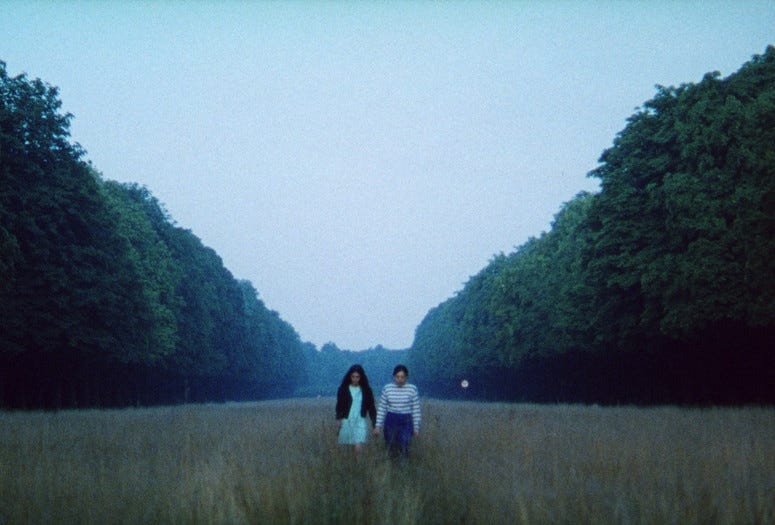
There is a scene in Portrait wherein the main character (the Young Girl), Michelle, is on the cusp of losing her virginity to a military deserter. After a day of aimless walking, wandering, and circular discussion, they break into an apartment owned by Michelle’s aunt and settle into an awkward stillness, their bodies static for the first time in several hours. Michelle has to leave the apartment before 8 p.m. She is meeting with her best friend, her true love, to attend a party that is quite some distance away. She is running truant, idling away her new freedom with this boy and their discussions of political unrest, belief, and lived illusions. It is never once clear as to whether she is remarkably self-assured or just incredibly, incredibly afraid. It does not appear to matter.
They enter a bedroom belonging to neither of them. The deserter says you’re so quiet now. Do you want to dance? He places a record on the turntable. Suzanne by Leonard Cohen begins to play. It seems to transcend the sonic into the holistic sensorial, the soft guitar occupying every corner of the screen and viewer as Akerman allows the song to play out in full, a heady, diegetic wonder. The audience is held captive for its near four-minute duration, watching with bated breath as the camera shifts, and cuts, and slips. It is a diabolical cheat code; of course I was going to cry. But the dull ache I felt, and still feel, at the centre of my chest was not due to this choice of song. Rather, I was crying for, and because of, the camera.
The deserter takes a shower. Beginning in the doorframe, the camera moves through the bedroom alongside the eyes of the deserter, following his gaze as it attempts to capture Michelle. You have a beautiful body, she says, her hands fiddling with her shirtsleeves. I want to see you naked. When he echoes this sentiment, she shakes her head. No. Then get under the covers, he says. They do. Although under the direction of a woman, the camera in this scene feels distinctly masculine: it is not overtly soft or tender, and the depicted occasion defies the conventional (and rosy) expectation of what a loss of virginity is, or should be. It feels too consequential to be special, even if it does seem groundbreaking, monumental, important. Rather, it enables the pervasive, ubiquitous gaze of the deserter, thus recognising Michelle as its automatic object, a made-vision of desire. It lingers on our young girl, and on his hands as they touch her, his wide palms making an insistent caress of her hair, face, and breasts. We are permitted to note the stiffness of her posture, the striped blue of her shirt, and then, a blur of sweet nothing, the screen filled with a deep, burnt umber, the colour of the sheets that have ensnared her. We linger on the entangled couple for a moment, and then Akerman cuts, a merciful respite. Then, Michelle is walking in the late evening. She approaches her friend, a beautiful girl in a party dress and delicate shoes. Everything feels different now.
My viewing of Portrait was preceded by an excellent introduction from MIFF Senior Programmer Kate Jinx, who referenced an interview Akerman had given in 2011 for the Viennale (thank you, Kate, for sending me this source!). Under the subheading Girl, the interviewer asks the director:
You always talk about yourself in terms of a fille, girl, daughter; one of your self-portraits is titled Portrait of a Young Girl in Brussels at the End of the ‘60s… Fille signifies youth but most of all a filiation, a heritage. For you does fille mean not to be a femme, a woman?
Akerman replies:
Possibly. Probably. I don’t know. I never grew up. I was always an overgrown child… I stayed a girl, the daughter of my mother. In the end I don’t know…
These words have stained my mind for a month now, playing on loop any time I manage to broach a mental impasse, a brief moment of psychological respite. I turned 22 this month, and have become aware that I am more frequently referred to as “woman” than “girl.” “Tell the woman what you would like,” a customer will say to their child, a direction that often precedes a shy request for popcorn and one enormous, snot-nosed sniffle. My friends have also echoed this change; their new sexual partners introduced as women and men, as if to indicate a distinct shift in maturity, a disavowal of both the juvenile and the former teenaged self. At what point does one transcend the girl, the daughter, and become the woman? Is it in the slimming of the face, in the small wrinkle that threatens to appear at the corner of the eye? Or, is it in the belief that we have ceased our filiation, that we cannot exist simultaneously as both woman and daughter, as parent and child? It seemed to me like an overnight change, and I woke up exhausted, a girl in a sea of women, my limbs colt-like and unsteady in the face of my final form, this evolved and totalising femininity.
The first Akerman film I saw was Jeanne Dielman, 23, quai du Commerce, 1080 Bruxelles (1975). It was in April of 2023, when I had only really just started to watch movies and still felt stifled and excluded by the cinephilic (by god, take me back). My then-boyfriend had brought me along and found it unimportant to inform me that it was over three hours long. He cited that I would enjoy it for its visual aesthetic and feminist perspective. Wow, colour me sold! I had consumed maybe four drinks at a bar beforehand, and then promptly fell asleep in the middle of the film, an unfortunate occurrence that later became both typical and expected. Seized with panic, I rapidly elbowed the boy next to me. What did I miss? I asked, eyes wide and still drunk. She’s just finished peeling the potatoes, he whispered, and now she’s putting them on to boil.
I awarded it a stunning 3 stars on Letterboxd. My review reads “Too long not much happened.” Contemptuous idiot.
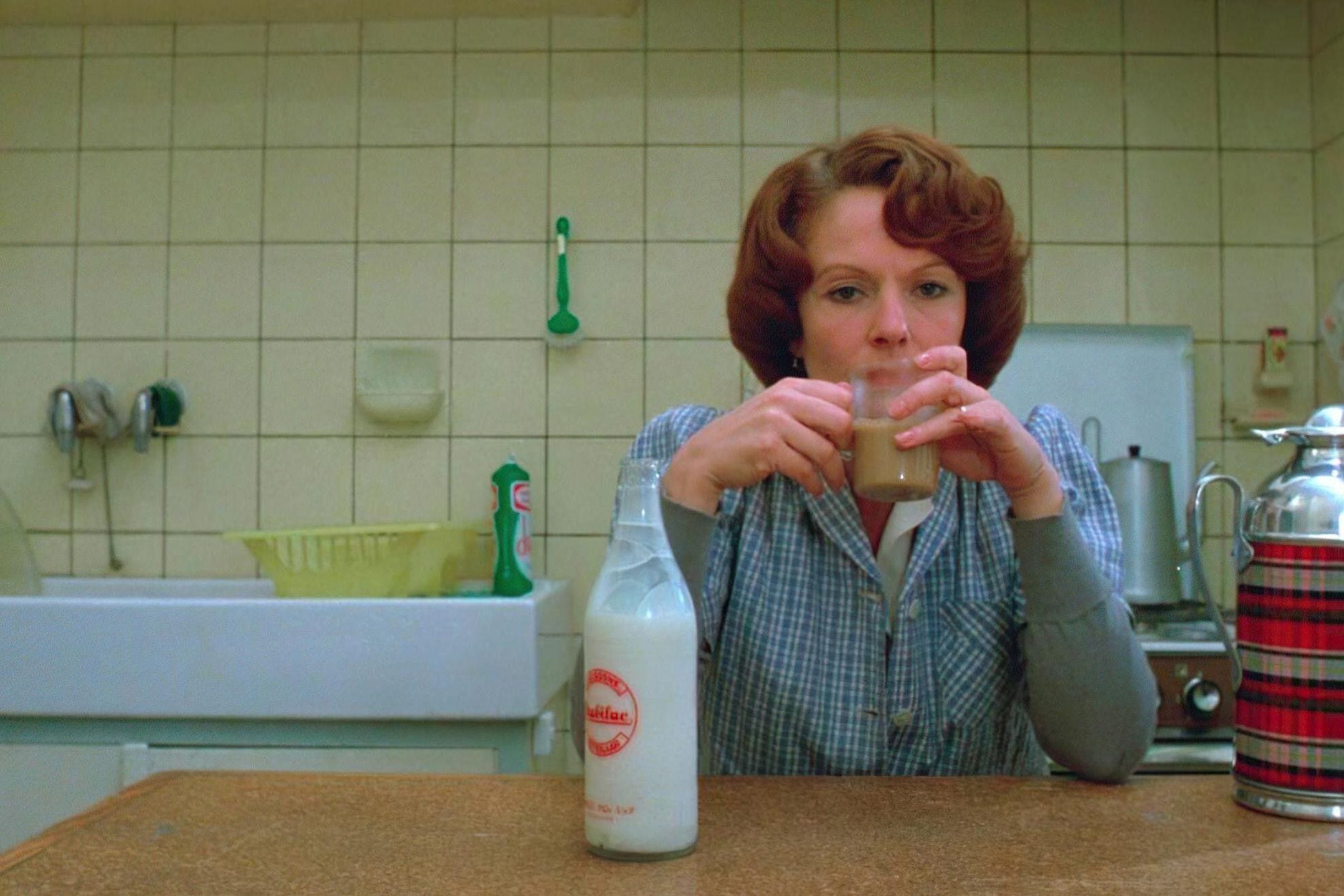
Jeanne Dielman spends its 202-minute duration chronicling three days in the life of its titular character. A widow who spends almost all of her time engaging in domestic routine and upkeep, Jeanne’s life is calibrated to ensure a predictable, expected outcome. We watch her as she cooks, eats, and cleans, as she goes to the shops in search of ingredients, and as she cares for her silent, thankless son, a man who reads during dinner and rarely looks her in the eye. The audience is painfully aware of these intricacies because they are literally tethered to Jeanne, the camera trained on her and her every move. Whether she is buying a button or cutting vegetables, the viewer experiences the domestic ritual alongside Jeanne for its near entire duration. There is no relief from this mundane consumption of time; Akerman does not score the film, and the regimented task is carried out in its banal, painful totality. The only exception to this “real-time” is the half hour Jeanne uses to participate in sex work, an evening window presumably chosen to conceal the act from her son, her shame apparent and all-encompassing. When her business concludes, the corridor adjacent to the bedroom has darkened. Jeanne turns the light on. She collects her payment from the client. She turns the light off. Then, it is time to prepare dinner. The kitchen light turns on. She sits down at the bench. She grabs the potato peeler.
Jeanne is portrayed by Delphine Seyrig, who has described her character as a “femme d’intérieur.” This phrase, which has no direct English counterpart, is often translated as “homemaker,” or “housewife,” the gendered keeper, the woman who maintains the domestic space. What it literally translates to, however, is “interior woman,” a thematic sentiment that is so pertinent to Jeanne Dielman that it becomes difficult to contextually separate once learnt. Jeanne is a woman kept, her responsibilities to her home and son inhibiting her from existing outside of ritual. She must remain controlled, for if she does not, she has no basis upon which to self-identify, no purpose, and no ability to utilise the wild freedom of the girl she has long ceased to be. And I can’t help but wonder as to whether Akerman’s resistance to the femme is in response to this notion of the interior woman, her unwillingness to “grow up” and to “remain the daughter of [her] mother” framed by her belief that to be a femme is to enter the cloister of the inside, a confined space dictated by ritualistic necessitations. The girl is free. She is akin to the maternalistic, and yet knows she is entirely separate. Her filial symbiosis can be maintained or devastatingly razed: it is completely up to her. She is on the edge of becoming, and her world is as vast and exciting as the landscapes that surround her (what does Addison say? The world is my oyster, and I’m the only…?). The life of the fille is hers for the taking, and she thus acts accordingly: there is no prescribed dogma that she must abide by, no singular entity (or interior) to whom she owes and must tend to. As Akerman later responds in the Viennale interview: “Sometimes I regret not having kids. Maybe I would have gone from a daughter to a woman – but whether that was possible for me, I don’t know. Probably not.”
I would be remiss not to mention John Berger’s Ways of Seeing (1972) here, and I cannot bring myself to feel bad about this predictability. “To be born a woman,” writes Berger, “has been to be born, within an allotted and confined space, into the keeping of men… A woman must continually watch herself… From earliest childhood, she has been taught and persuaded to survey herself continually.” This surveillance is what bonds both fille and femme, mother and daughter. The sight, or gaze, is an omnipresent force, it is rampant in both the interior and exterior. Under the masculine eye, every woman is an object, a scrutinised form whose being is directly influenced by her imminent physicality. Within the field of vision, there is no possibility for the femme to exist as separate to her interior: it is a male usurper, a dictator of presence and permissibility.
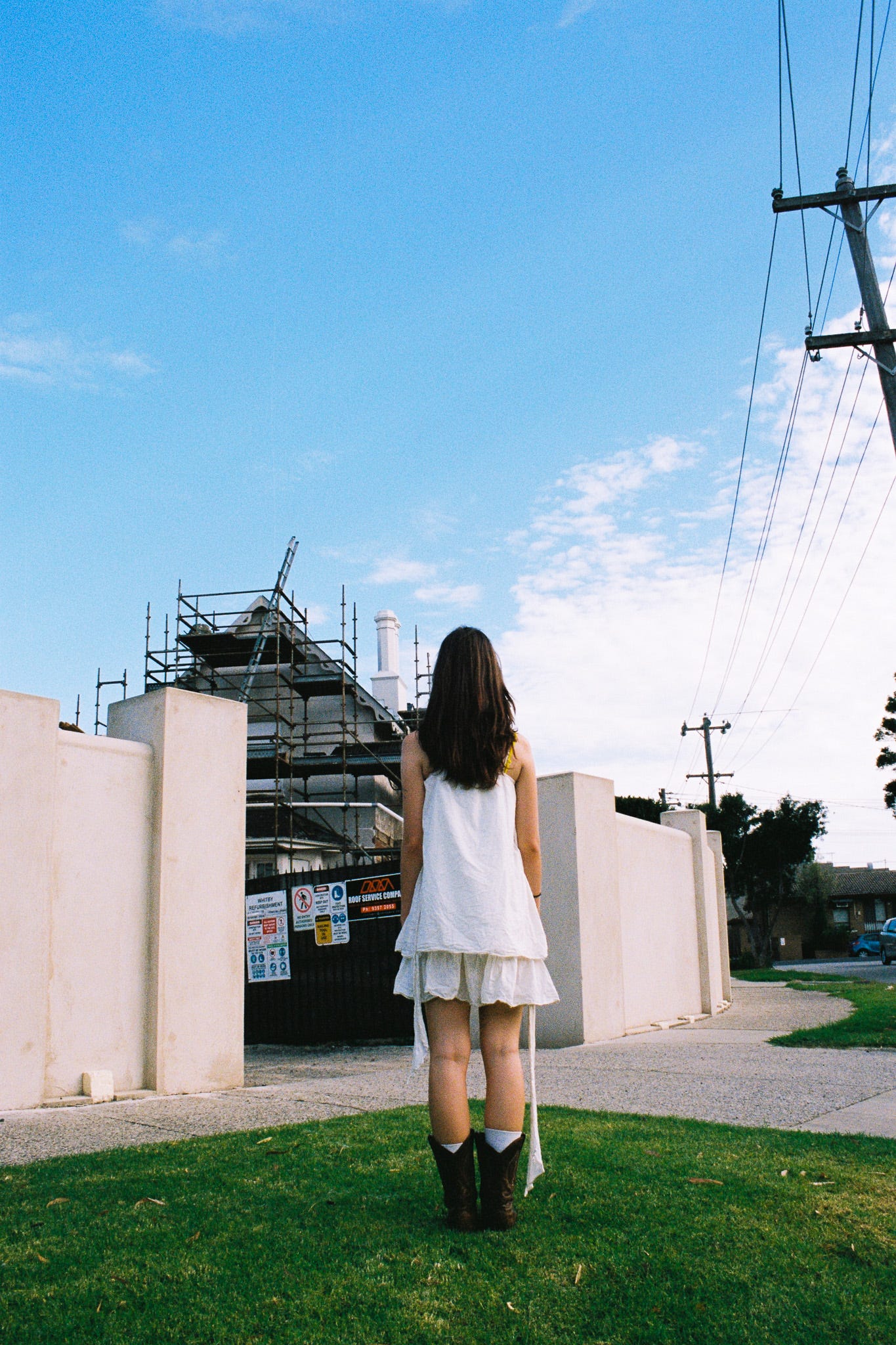
However aware one is of this gaze, I still posit that girls seem to belong to the exterior world. Their existence contains the imminent potential to do, to see, and to explore. It is a state of being defined by wonder, and guided by every wayward desire of the heart. When the ubiquitous nature of surveillance transcends the bearable and becomes crushing, overwhelming, the girl is then forced inside for safety, turned away from the harsh, brisk world and back towards engineered recognition, her predetermined fate. Though she may momentarily evade the domestic interior, she will inevitably turn back towards her own, her self collapsing like a supernova or black hole. The second she becomes aware of a gaze upon her, there is a restriction of freedom, a sensorial barrier placed between the girl and the world at large, a world catered to the view, to the sight, of men. A woman walking on the street is a spectacle, a thing to behold. One night a couple of years ago, I was passing through Carlton Gardens when I encountered a man on a park bench who was openly masturbating. “I’ll give you a thousand for her,” he shouted to my boyfriend, his face obscured by the dim street light. We moved on swiftly, and I think I laughed afterwards, but it took me another year before I could cut through the park in the same careless manner, that diagonal passage made impossible by the void of horror that had instantaneously corrupted its centre, an interior leak.
The second I became fully conscious of this gaze (sometime between age twelve and sixteen), I myself began to turn inwards. I engaged in self-starvation. I made interrogative video after body-checking video; the camera an instrument of harm, its use not dissimilar to an occurrence in one of my early sexual encounters. It was an aggressive appendage that I used to monitor my descent into interiority, to assess the effectiveness of the routines I partook in, and, most importantly, to ensure I was below sexuality and safely removed from the surface of my femininity. Though I was petrified of becoming a woman, I was synchronously turning into one, a femme d’intérieur, my body a false home, something to be made and ritualistically maintained. In an attempt to preserve this slipping girlhood that I so desperately clung to, I instead stripped myself of my ability to smudge, mark, or blemish, the very characteristics I now associate with the girl, with Akerman’s fille. My anger turned inwards, I was performing a stigmata against gaze, a protest against sight and vision. I had crafted my own perception. It felt like reclamation.
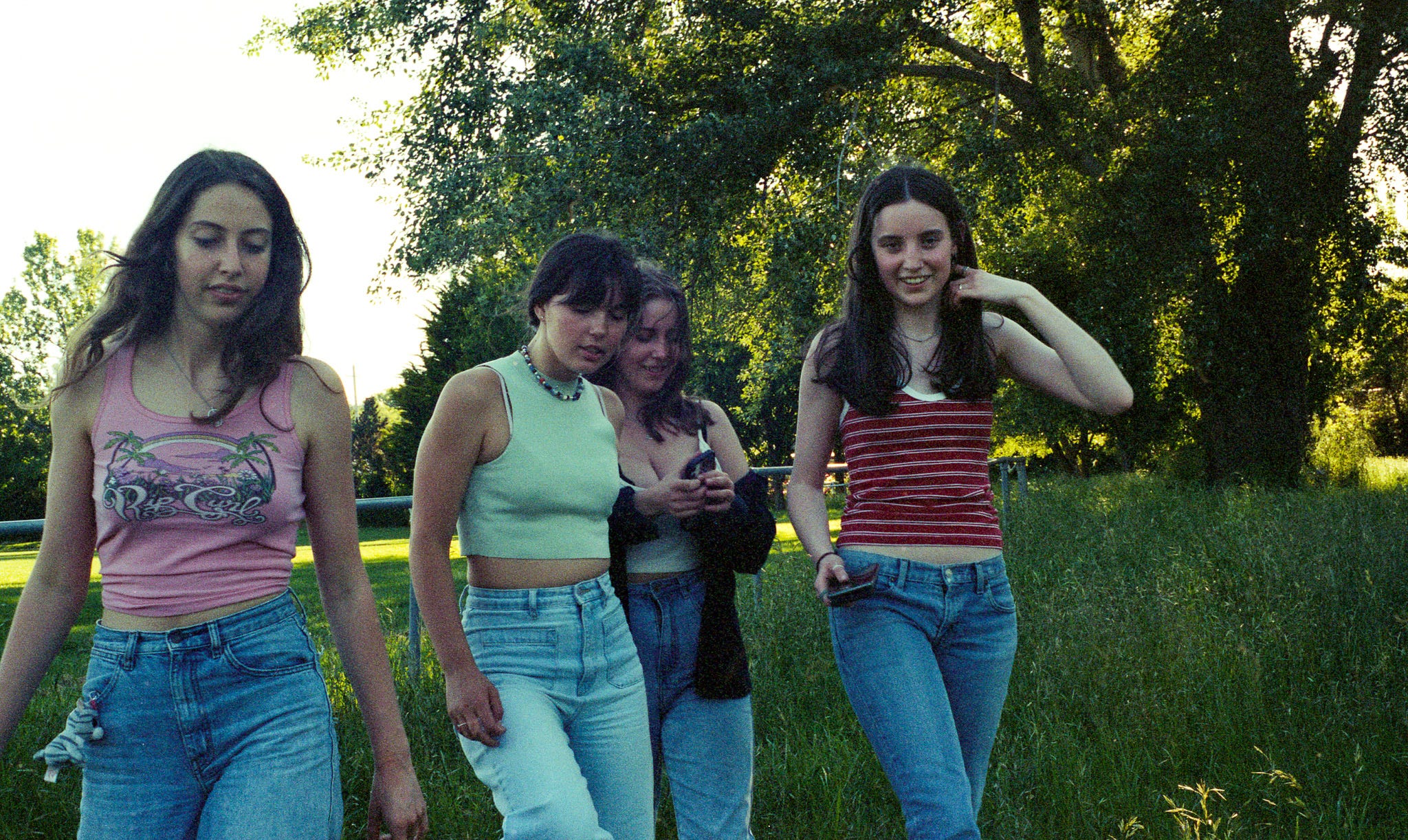
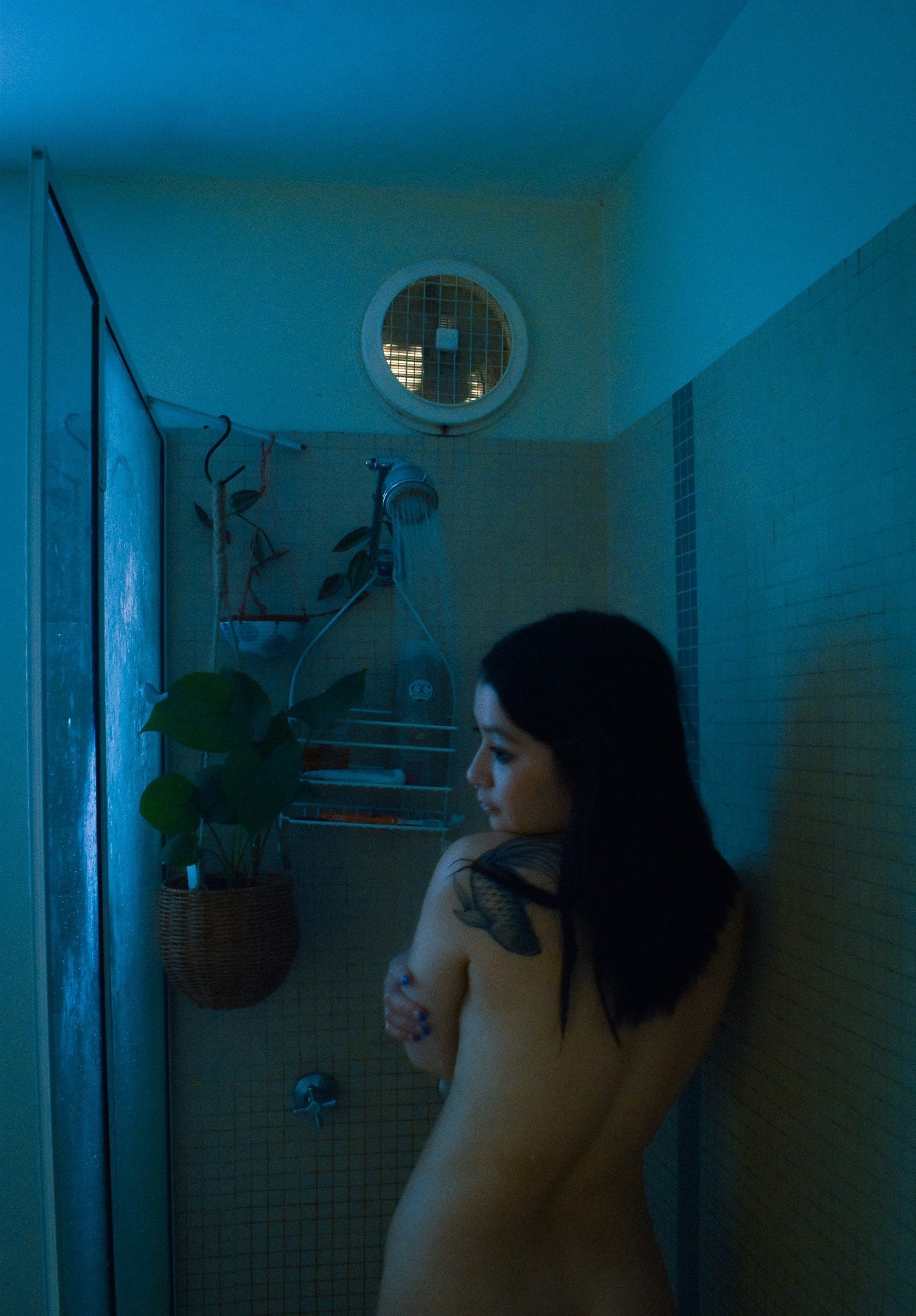
It is odd to me to consider this period of my life as coinciding with my adoption of the photographic. I have never taken more pictures than I did in my initial volley with my eating disorder, and never did I have more fun doing so. My friends were willing models. They were game for whatever I was attempting to execute. I have hundreds and hundreds of negatives from this time of tried (and mostly failed) scenic experiments, of girls trapped in a seventeen-year-old limbo, frozen within the interior of a bathroom, bedroom, or the suburban “inside”: a lamp post, an empty street, a grassy oval. While these certainly are defined (and debatably confined) places, the girls in these photographs never felt stuck to me. Laughter exists just beyond the depicted scene, as does a scraped knee, a drunken outburst, a full-bellied, toe-curling sob. I used to write about my photographic work as belonging to the psychologically stifling and uncomfortable, a sense of play made sinister through an underlying sense of unease and a projection of individual discomfort. I understand now that it was always about my desire to contort and control this sense of surveillance, a visual force that seemed to permeate every aspect of my life. Lying alone in my bedroom, I would think about the suitability of my pyjamas for an instance of home invasion, or for the accidental automation of a 24/7 livestream, a freak laptop virus. Curled in foetal position, I thought not of sleep, but rather of what my future boyfriend would think of my body, of the way it would fold and contort as I laughed, or rested, or slouched. Would he think I was attractive? Worthy of touch? Fit to be an accessory to his life, worn on the hip like a holster? I studied myself like a voyeur would, donning his shoes with such frequency that my feet had managed to indent their soles, the small mark of my gravity against his, an irrefutable stain of my fear.
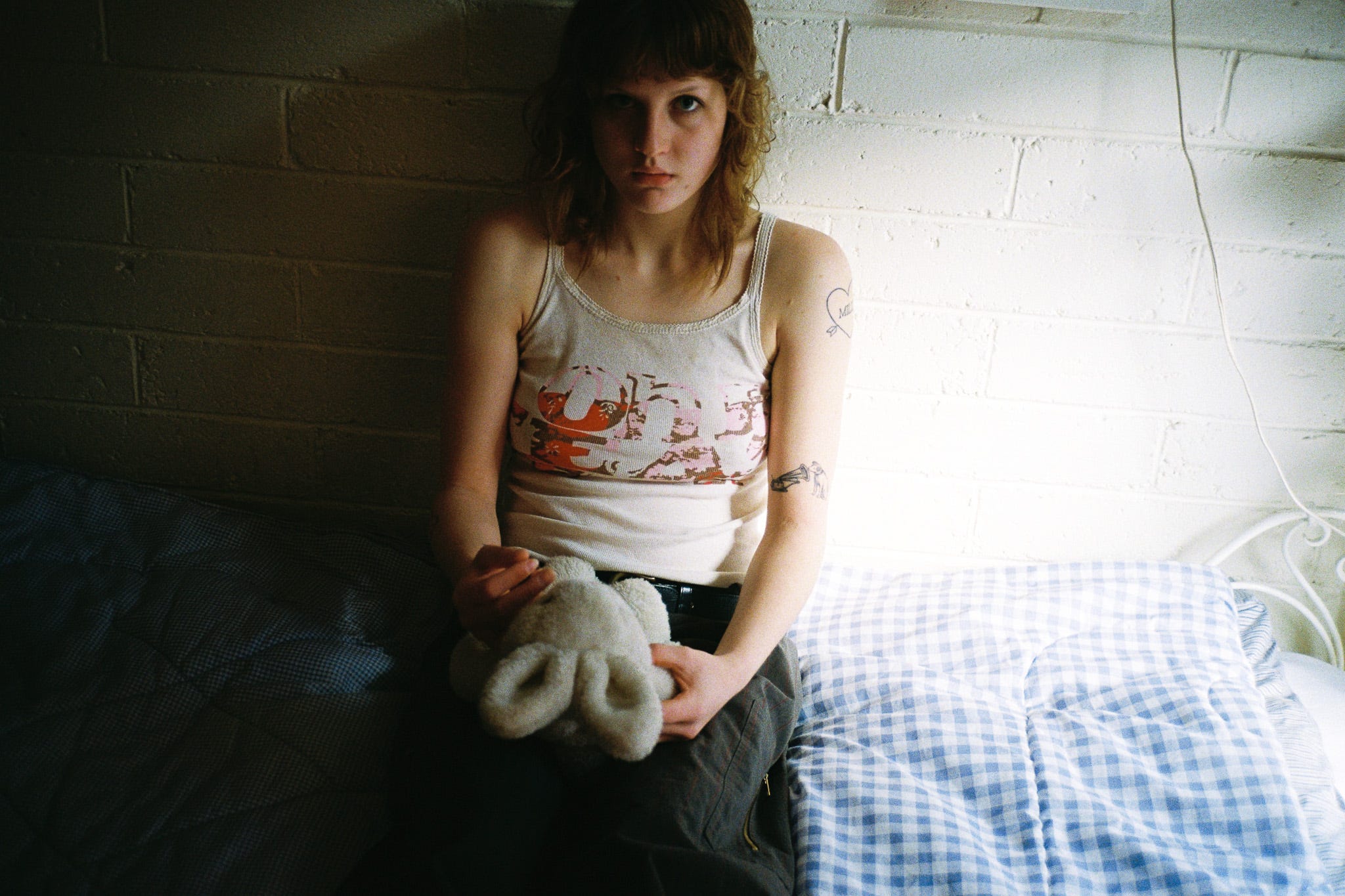
In both photographic and cinematic history, the feminine desire to construct a personal, visual language is nothing groundbreaking. I have mentioned Akerman already, but then there is, of course, Cindy Sherman and Barbara Kruger. There is also Nan Goldin and Francesca Woodman, Claire Denis and Barbara Hammer. There is Agnes Varda, and Lynda Bengliss, and Martha Rosler. In more recent years, there is Petra Collins, Juno Calypso, and John Yuyi. I could keep going, and going, but I won’t, because you get the picture (pun intended). It is no coincidence that the photographic connotation with documentary, advertisement, and the historical “truth” resulted in a feminist subversion of the medium: it permits women to automate a view of their own, a perspective developed from and in response to this dominant patriarchal narrative, the very same gaze that transformed woman into “an object of vision: a sight” (Berger, again).
It is thus significantly easier to automate one’s freedom through the notion of the “self as camera.” There is no lens that exists in one’s experience as a woman beheld, at least not under the patriarchal sight. To be a woman is to be understood through the lens, not to exist as one. The sight, the vision, and I mean that canonically, is male. The camera, though I loathe to admit it, can therefore be seen as an apparatus used to activate this sight, a machinic masculine. And this is why I find myself drawn to it, why I must invariably return to indent the shutter time and time again. The photograph is a memorial of light, and time, and of a sight that belongs to me, one that is sharp, and tender, and all mine (or at least as much as it can be). In doing so, I create a new kind of ritual, one that immortalises my exterior: a mark beyond the spectrum of my woman as she is framed and then framed again, her vision blinking in and out of clarity in the dull reflection of a city window.
Why was I so struck by Portrait? What freedom did I sense in Michelle, in her boldness, her sensitivity, her frame as it ran ragged and sure-footed through the winding streets of Brussels? I had not picked up my camera in months, steeped in a post-undergraduate rejection of the single thing I had loved enough to study. In time, I lost the drive that prompted me to begin taking images in the first place, my want to mark, to stamp, to ascertain that yes, I have been here in this world, a girl woman, right here, right where you are looking, standing, feeling. Susan Sontag writes in On Photography (1977) that “photographs furnish evidence. Something we hear about, but doubt, seems proven when we're shown a photograph of it.” I was moved by Portrait, and by Akerman’s camera, as it reminded me as to precisely why I have always seemed to photograph girls. There needs to be proof that there is more to feminine life than its interior, more to living than the act of being looked upon, imprisoned in the cage of vision. As depressingly perpetual as the gaze is, the photograph let me craft an alternative way of seeing, permitting me to return to the girl, to the exterior, to a life without ritualistic destruction. I live in uncertainty now: half girl, half woman, a purveyor of sight, an object of vision.
In my last semester of university, one of my classmates received frequent and overwhelming critiques about her continuous depiction of “girlhood.” A couple of flowers pulled just into focus. Her boyfriend in the bathroom, immortalised in violent magenta. Doonas that belonged to her mother, and the form of their piles atop a plush, wood-framed bed. Her friend exalted in the early Winter, hair haloed by wind, the graceful line of her neck exposed. We all protested. But what do you actually mean by that? What about these pictures screams “girlhood” to you? A debate ensued. Decibels rising by the second, we carried on and on until our tutor interrupted, a brilliant woman with a shock of bright, cropped hair and a very intense, pondering cadence.
“The word that comes to mind,” she said, her finger curved in gesture, “is smudge.”
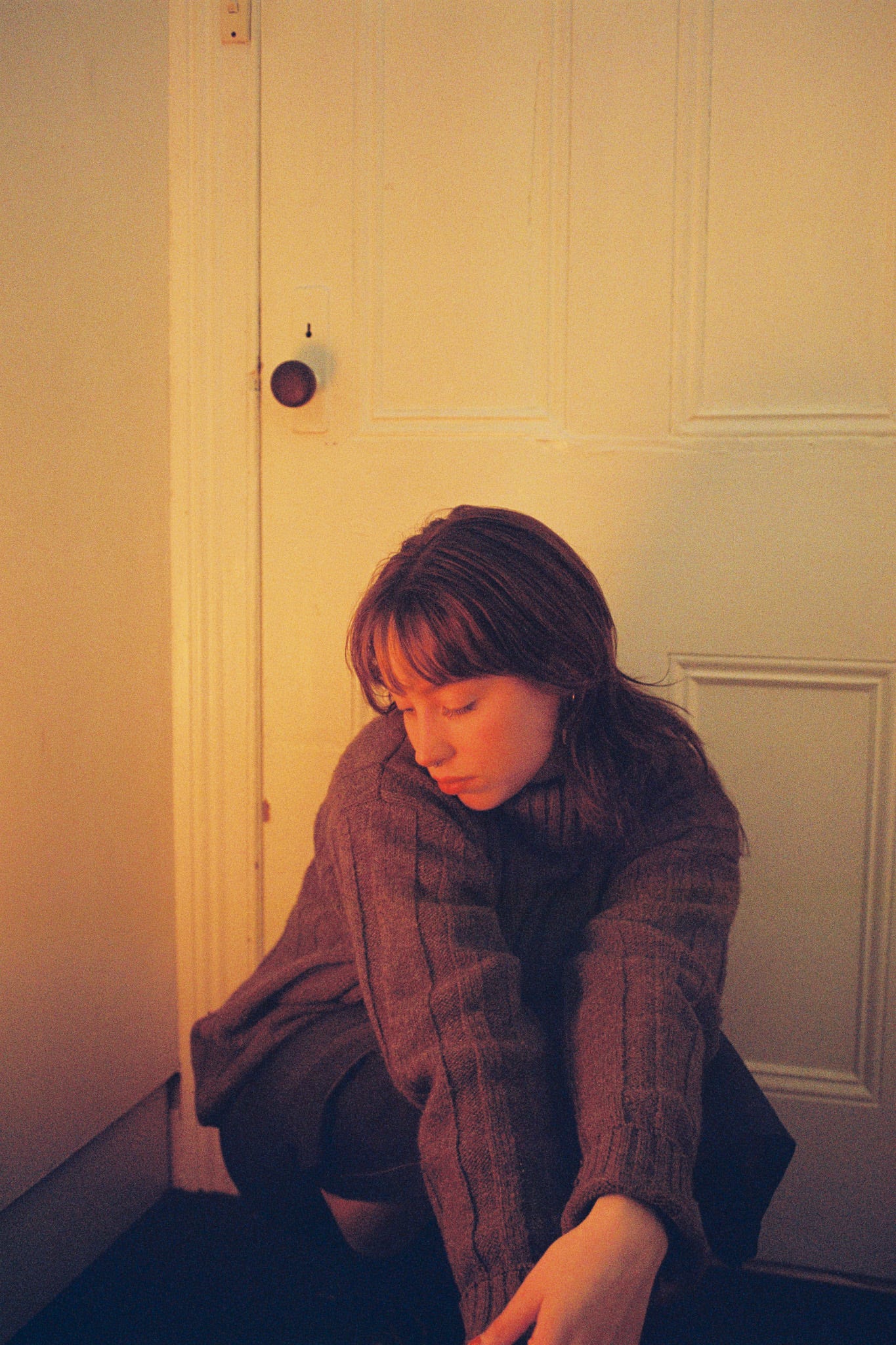
The girl, my girl: a smudge, a force, a blemish, the image. The mark of my world, just as I see it.
🩷